
Why creativity belongs in Medical Affairs
And why it’s more than a “nice to have”.

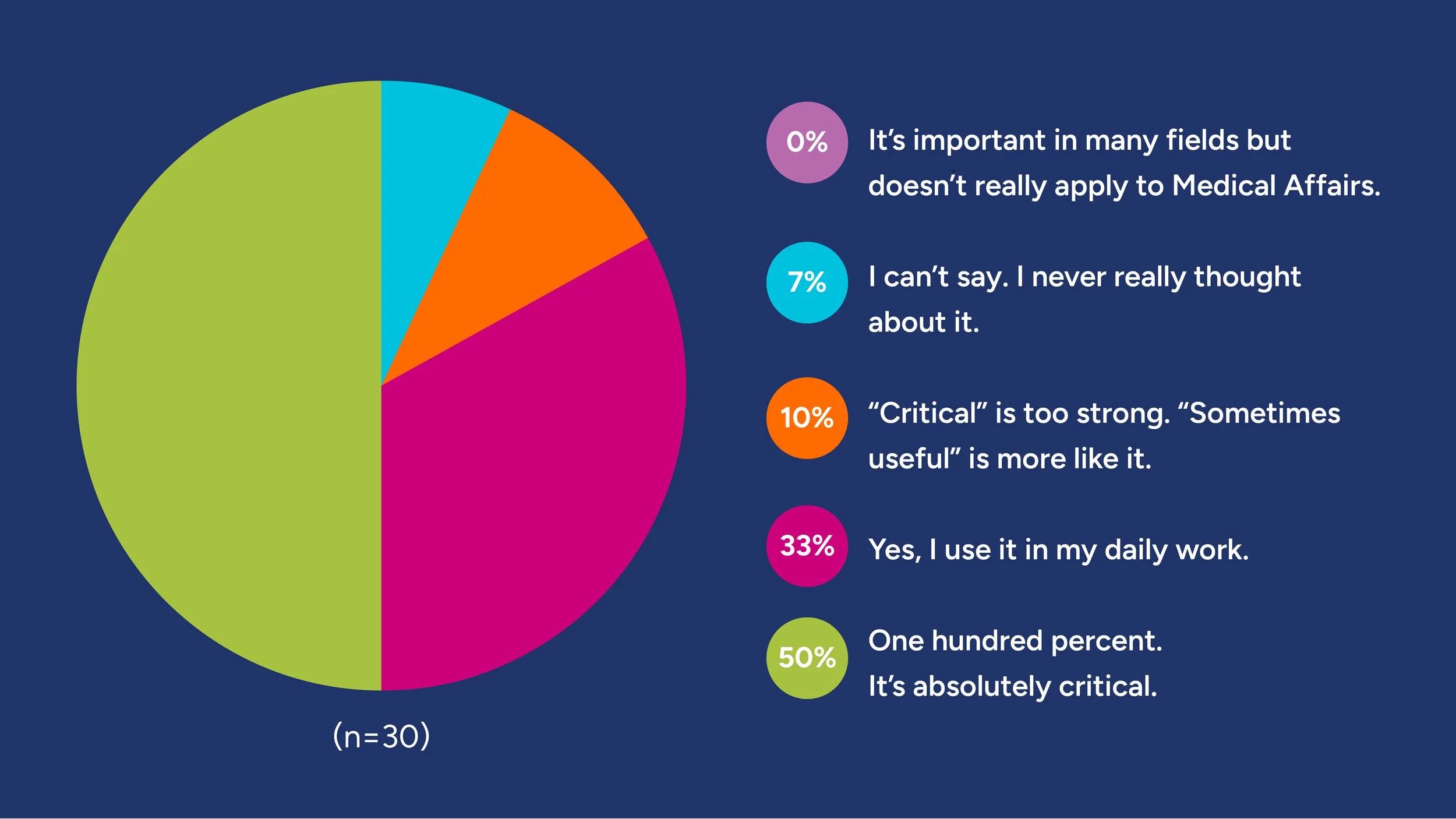
When we asked a simple question during a recent Medical Affairs webinar—“How critical is creativity as a tool for Medical Affairs professionals?”—the answer was surprisingly clear.
50% said creativity is ‘absolutely critical’. Another 33% said they ‘use it in their daily work’.
That consensus matters, but the remaining 17% suggests that creativity is still not fully understood in Medical Affairs. It’s frequently seen as something informal, subjective, or even risky—nice in theory, but hard to reconcile with SOPs, regulatory guardrails, and the demand for scientific rigor. And yet, the people doing the work every day are telling us something different: creativity is already part of the job.
The real question isn’t whether creativity belongs in Medical Affairs.
It’s why it matters—and what happens when it’s missing.
Poll results: Creativity is a critical tool for Medical Affairs professionals.
Creativity isn’t about inspiration. It’s about discipline.
One of the biggest myths holding teams back is what we sometimes call the “Van Gogh fallacy.” We tend to associate creativity with spontaneous brilliance—the lone genius struck by inspiration. In reality, even history’s most creative figures were disciplined professionals who explored ideas methodically over time.
The same is true in Medical Affairs. Creativity doesn’t mean abandoning rigor. It means approaching complex, human problems with curiosity, structure, and intention—especially when the “right answer” isn’t obvious.
And Medical Affairs is full of those problems.
Why creativity matters specifically in Medical Affairs
Medical Affairs sits at a unique intersection: science, stakeholders, and constraints. That combination makes creativity not optional—but essential.
Here’s why:

1. Stakeholder needs are complex—and often conflicting
HCPs, patients, caregivers, internal teams, and systems all experience disease, treatment, and evidence differently. Creativity allows Medical Affairs teams to look beyond surface assumptions and recognize unmet needs that aren’t always articulated clearly.

2. Constraints don’t reduce the need for creativity—they increase it
Working within SOPs and regulatory frameworks doesn’t eliminate creativity; it raises the bar. The challenge becomes: How do we deliver meaningful, compliant solutions that still resonate in the real world? Creativity helps teams find new ways to work within established boundaries rather than defaulting to familiar approaches.

3. Productivity pressure demands relevance, not just volume
As Medical Affairs teams are asked to do more with limited time and resources, creativity becomes a force multiplier. Programs that are better aligned to stakeholder realities are more likely to land—reducing rework, late-course corrections, and “perfect” initiatives that don’t make the intended impact.

4. The environment is changing faster than playbooks can keep up
New data, evolving standards of care, shifting stakeholder expectations—static approaches struggle to keep pace. Creativity supports adaptability by encouraging learning earlier and responding thoughtfully to emerging challenges.

5. Creativity supports teams, not just outputs
There’s also a human dimension. When teams feel equipped to explore, test, and improve ideas—rather than defend assumptions—job satisfaction increases. Creativity supports better problem-solving and professional well-being.
So where does Design Thinking fit?
Creativity alone isn’t enough. What Medical Affairs needs is a way to harness creativity without turning it into chaos. This is where Design Thinking comes in.
Design Thinking is best understood not as a trend or a workshop, but as a human-centered approach to applied creativity—one that starts with real people, emphasizes learning over assumption, and helps teams navigate ambiguity in a disciplined way.
Importantly, its been used for decades in industries facing similarly complex, high-stakes challenges. Its relevance to Medical Affairs lies in its ability to bring structure to creativity—without sacrificing nuance, scientific rigor, or regulatory requirements.
From concept to action: one tool to get started
To make this practical, M Health has developed a Design Thinking approach tailored specifically to Medical Affairs workstreams—from evidence generation to education, pathway optimization, and engagement.
If you’re curious, we’re offering a practical starting point:
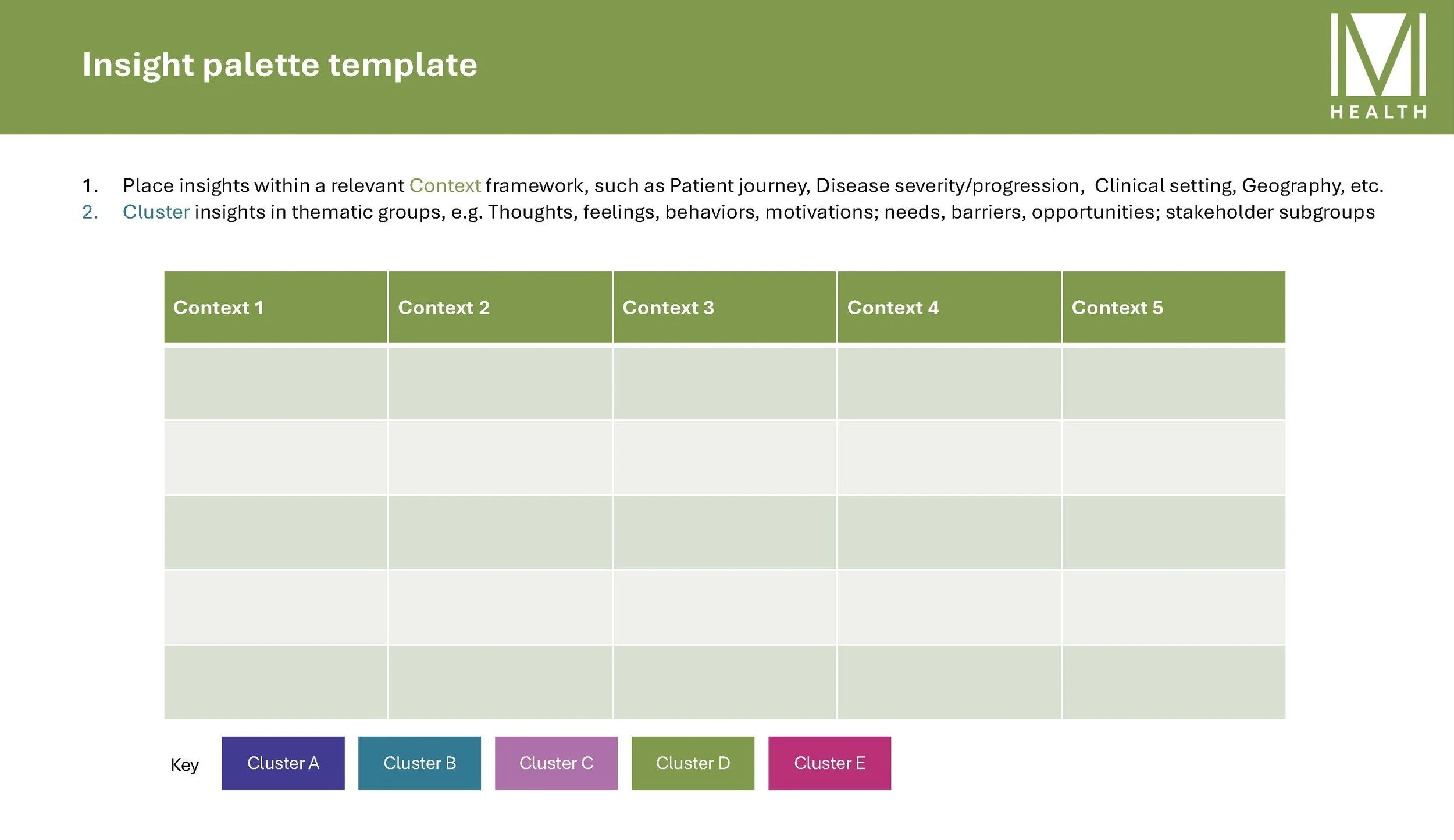
Free preview: The “Insight Palette” template
This simple framework helps teams organize stakeholder insights by context (e.g., patient journey, clinical setting) and theme—before jumping to solutions. It’s a small example of how structure can sharpen creative thinking without oversimplifying reality.
Want the full “how” on applying Design Thinking?
If you’re interested in how Design Thinking can be applied step by step in Medical Affairs—along with practical templates and a tailored walkthrough—we’d be happy to connect.
Schedule a meeting with M Health to explore the full Design Thinking approach and see how it can support your team’s priorities.